

Rehearse the cyber crisis before it is real.
A flight simulator for your crisis cell
Cybertactik is a cyber crisis simulation your leadership team plays live. Everyone joins at the same time, each person in a role, and the team works a realistic attack from the first alert to the debrief. The mistakes get made here, where they cost points instead of patients, clients or a reputation.
Your team rehearses a real attack, in real time.
Every decision has a price the whole room can see.
You find the holes in your plan before an attacker does.
The rules of the game
Up to eight people, one browser each, one clock for everyone. Nothing to install: an invitation link opens a seat.
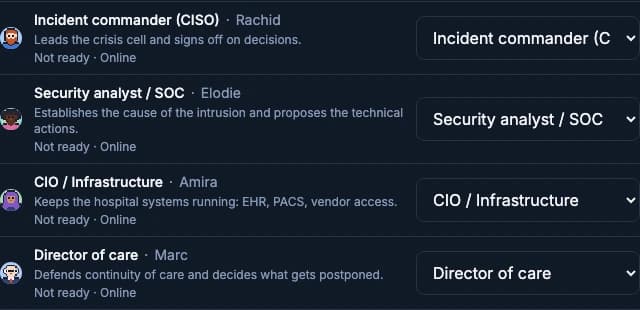
Everyone has a role
Incident commander, SOC, operations, business, communications, legal, chief executive, board. Each seat sees its own cards and carries its own decisions. An empty seat can be played by the scenario.
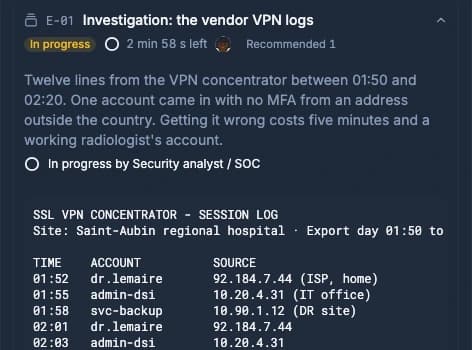
Find the evidence
Logs, emails and exports hide what actually happened. A right answer unlocks the next moves. A wrong one costs time, money and stress, and sends the team down a false lead.
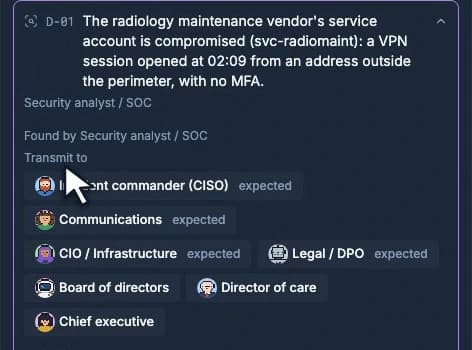
Share what you know
One role finds, another acts. Players write to each other one to one and pass their findings to whoever can use them. Nobody gets through it alone.
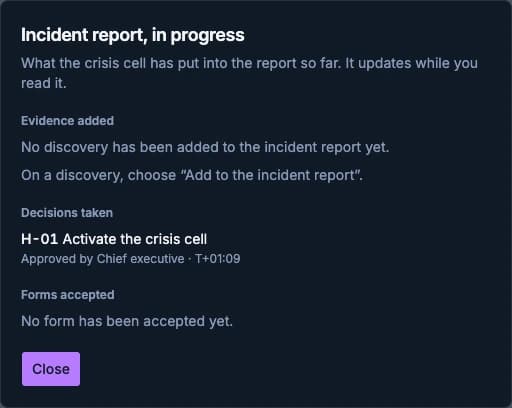
Put it in writing
Situation reports, holding statements, escalation requests. The fields are filled with what the team has found and shared, so a report built on a guess shows.
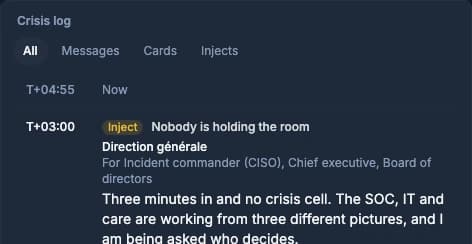
The crisis keeps moving
The clock runs and new events land while you work: a service goes down, management wants answers, a new alert shows up. The session moves through five acts, from onboarding to the debrief.
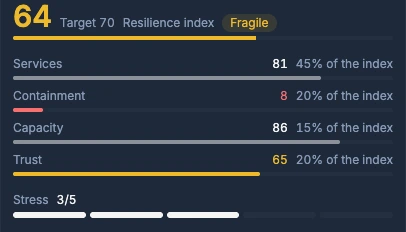
Every choice costs something
Isolate the network and care slows down. Wait, and the attacker gets further. Gauges for services, threat, capacity, trust and team stress show what each decision did.
At the end, a report for your board
When the clock stops, Cybertactik writes up the session from what the team actually did.
Every decision, with the time it was made
Five scores
The key moments of the session
A written after-action account
You hand it to your board, your insurer or your auditor.
Scenarios
One scenario is published and playable today. Three more are being written.
 Available
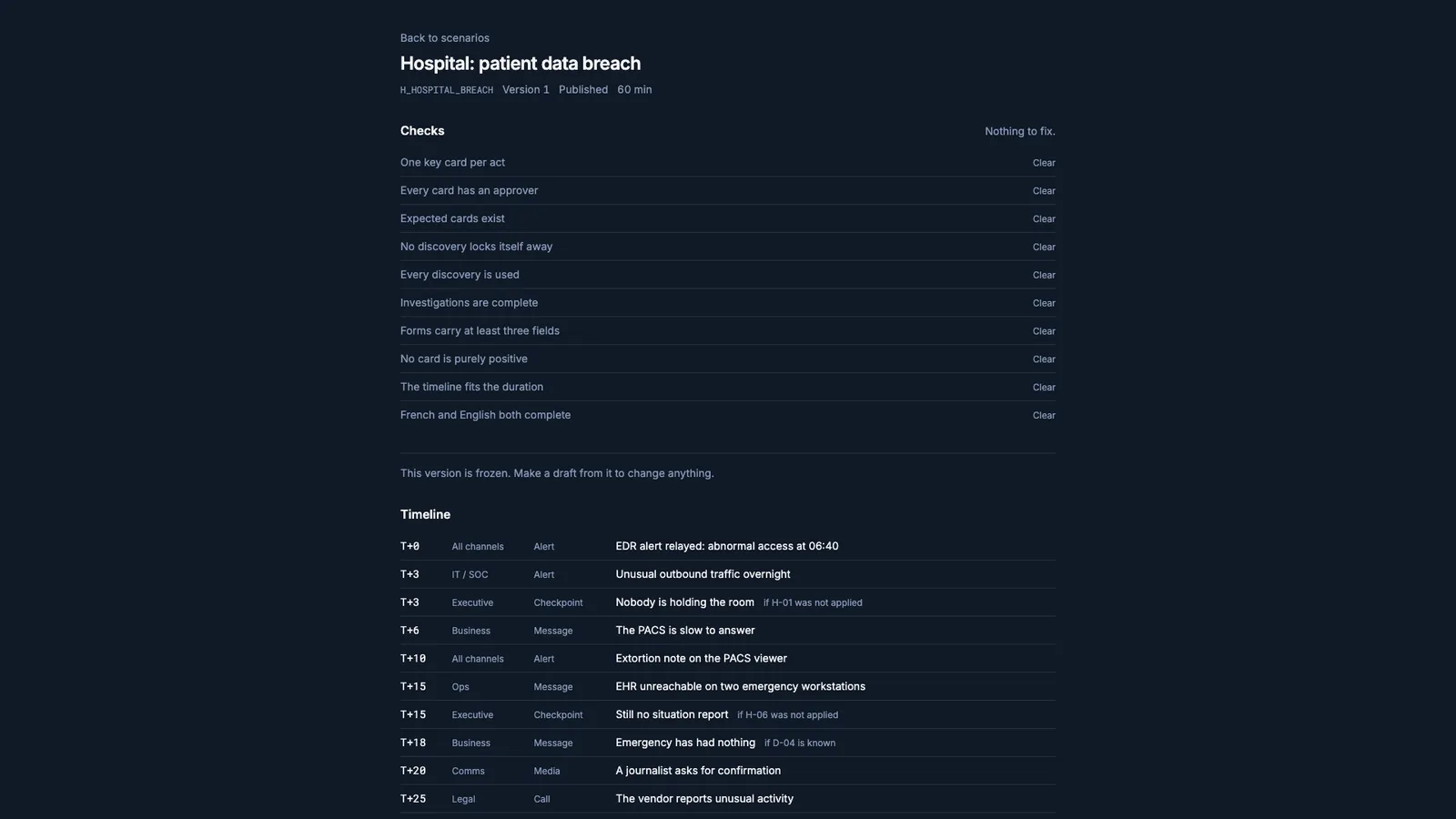
Hospital: patient data breach
An endpoint alert at 06:40 that nobody has read, and 48,200 patient records that left the building overnight, between 02:14 and 04:36. Eleven hospital services, forty-five minutes on the clock.
 Coming
Factory: DDoS and production stoppage
A denial of service on the plant network, and a production line at a standstill.
 Coming
Warehouse: ransomware and blocked shipments
Ransomware in the warehouse systems, and shipments that stop leaving the dock.
 Coming
Hospital: pharmacy paralysed
The hospital pharmacy is at a standstill and the wards still need their medication.
Create your own cyber crisis scenarios
Tell us your sector, your systems and the crisis you fear most. Brainstorm builds the scenario with you, AI does the heavy drafting, and your team plays your own crisis.
Who makes it
Cybertactik is built by Brainstorm CyberRisk, an independent cyber risk firm working from Montréal, Paris and Fort-de-France. Its founder, Tania Tanic, created it after more than 27 years leading cybersecurity and governance in financial services, public investment and other regulated sectors, in Canada and Europe.
brainstorm-cyberrisk.com
Request a demo
Tell us who you are and Brainstorm sets up a session. You watch a crisis cell play the hospital scenario, then you read the report it produced.
Rehearse it.